

Vomiting is one of those things every dog and cat owner deals with at some point, and most of the time a single episode after a fast meal or a questionable backyard snack is not a cause for concern. The picture changes when vomiting becomes a pattern: weekly episodes, vomiting paired with weight loss, vomiting that brings up bile or foam instead of food, or vomiting in a pet whose appetite or energy is quietly shifting. At that point, the right answer is not another round of bland food or hairball remedies but a workup that figures out what is actually going on, since chronic vomiting in either species usually traces back to a GI (gastrointestinal) condition, a systemic disease, or a dietary issue that will not resolve on its own.
Twin Maples Veterinary Hospital in Dayton is open seven days a week and AAHA accredited, with in-house diagnostics, digital radiography, abdominal and cardiac ultrasound, and endoscopy under one roof. Our veterinary services cover both the testing and the team approach these cases call for. If your dog or cat is vomiting more than feels right, book an appointment with us and come in to get some answers.
What Counts as Chronic Vomiting?
- Frequency matters more than the single episode: weekly vomiting in either species is worth investigating.
- The contents tell a story: bile, foam, undigested food, and hair each point in different directions.
- Context decides urgency: vomiting alongside weight loss, appetite change, or low energy means a workup.
- It is not always a stomach problem: systemic diseases drive vomiting too, especially in older pets.
When Is Vomiting Actually Chronic?
A pet who vomits a few times a year, recovers within hours, and otherwise looks well is rarely cause for alarm. Vomiting becomes chronic when it happens often enough to count as a pattern, generally weekly or more, or when it persists for more than two or three weeks. That definition holds for both dogs and cats, though they each have their own versions of the chronic vomiting picture that we will get into.
The reason chronic vomiting deserves a real look is that pets often act bright between episodes, eating well and behaving normally, which makes the vomiting easy to write off as a quirk. Underneath that calm picture, a low-grade GI condition or systemic disease may be working steadily. Inflammatory bowel disease, food allergies, chronic pancreatitis, early kidney disease, and gastric ulcers can all produce months of intermittent vomiting in an otherwise normal-looking pet. Treating chronic vomiting as background noise is exactly how these conditions go unaddressed until they progress.
Is It Vomiting or Regurgitation?
This distinction matters more than most pet families realize, and the difference shapes the entire workup. Vomiting is an active process: the abdomen contracts, the pet retches forcefully, and partially digested food (usually with stomach acid or bile) comes up. Regurgitation is passive: undigested food appears at the mouth without any heaving, sometimes immediately after eating and sometimes hours later, often in a cylinder shape that reflects the esophagus.
Regurgitation points to esophageal problems rather than stomach problems, including conditions like megaesophagus where the esophagus has lost its ability to push food along. The workup for regurgitation includes different imaging and a different set of differential diagnoses than vomiting, and treatment usually involves changes to how the pet is fed (elevated feeding, smaller meals, specific food textures) rather than the medications used for vomiting. If you are unsure whether your pet is vomiting or regurgitating, capture a quick phone video the next time it happens. That short clip is one of the most useful diagnostic tools we have.
How Does Chronic Vomiting Look Different in Dogs Versus Cats?
Both species can develop chronic vomiting, but the patterns and most common causes are distinct enough to be worth understanding separately. The appearance of vomit also helps sort out causes: yellow bile, undigested food, foam, mucus, or a coffee-ground-like appearance all mean different things and point to different causes.
In dogs, chronic vomiting often traces back to dietary indiscretion patterns (the dog who repeatedly raids the trash, eats inappropriate things on walks, or counter-surfs), food sensitivities, chronic pancreatitis, IBD, liver or kidney disease, and gastric or intestinal foreign bodies that cause a partial blockage. Bilious vomiting syndrome is a specific dog pattern where vomiting happens first thing in the morning or after long fasts, with bile pooling in an empty stomach. Certain breeds also carry predispositions: brachycephalic dogs (Bulldogs, Pugs, Frenchies) often have chronic regurgitation and vomiting from their airway and esophageal anatomy, while Boxers and German Shepherds see higher rates of IBD.
In cats, chronic vomiting more often presents as the “frequent hairball” pattern, where what looks like grooming-related vomiting is actually IBD, intestinal lymphoma, hyperthyroidism, chronic kidney disease, or a food sensitivity. Cats are masters at masking how they feel, so weight loss may be the most reliable sign that something is genuinely wrong even when the cat seems otherwise content. The IBD and intestinal lymphoma overlap is particularly important in cats, since the two conditions can look identical on bloodwork and ultrasound and require biopsies to distinguish.
What About Hairballs in Cats?
Hairballs deserve their own section because they are so frequently the explanation reached for when a cat vomits, and the “it’s just hairballs” framing is responsible for a lot of delayed feline diagnoses.
A genuine hairball should only happen about once a month, maybe a little more in long-haired cats and less in short-haired ones. What is not normal is a cat producing them weekly, or a cat of any coat length vomiting regularly. The cats-just-do-that belief is comforting but inaccurate, and frequent hairballs are one of the most overlooked early clues in feline medicine.
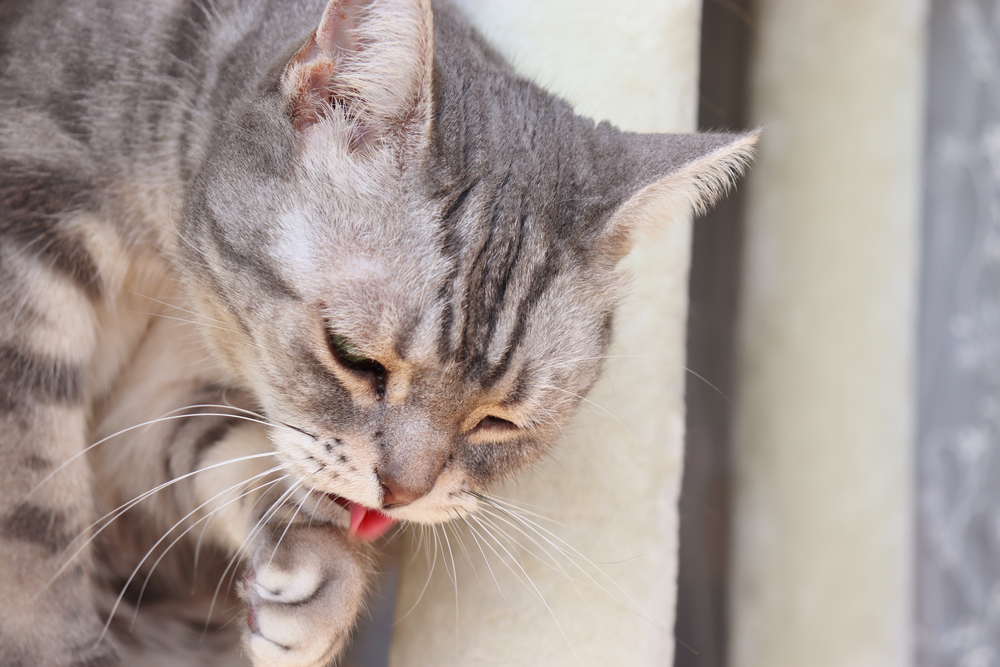
Hairballs form as a byproduct of grooming. A cat’s tongue is covered in tiny backward-facing barbs that pull loose hair into the mouth, and most of that hair passes through the digestive tract and out in the stool. A hairball forms when some of it collects in the stomach instead.
The picture changes when:
- A cat grooms far more than usual, because anxiety, itchy skin, or pain anywhere on the body can drive overgrooming, and the extra swallowed hair shows up as more frequent hairballs.
- A cat is grooming normally, but the intestines have slowed- often due to IBD or lymphoma- keeping the hair from passing normally in the stool, causing increased vomiting.
A rising hairball count is often the body flagging a different problem rather than a grooming quirk.
When Is Vomiting an Emergency?
Some patterns mean you should skip the wait entirely and head in the same day. In both species:
- Vomiting blood, or coffee-ground-looking material
- A swollen, painful, or distended belly
- Repeated unproductive retching (a critical sign in deep-chested dogs for bloat/GDV)
- Inability to keep water down
- Marked lethargy, weakness, or collapse
- Severe abdominal pain
Older pets in either species deserve a lower threshold, since the senior pet health problems that first appear as vomiting are often kidney disease, hyperthyroidism in cats, or organ disease that progresses without obvious early signs. We are open seven days a week, which makes getting in for an urgent case easier than at clinics with limited weekend hours.
What Causes Chronic Vomiting in Dogs and Cats?
Once an isolated episode is ruled out, the causes group into a few overlapping areas.
- Food and diet: thoughtful pet food selection matters, since true food allergies, non-immune intolerances (often to fat or fiber), high-fat treats, and constant diet switching all keep symptoms going. Our nutrition counseling helps match a diet to the problem.
- Dietary indiscretion: especially common in dogs, where raided bins, swallowed fabric or socks, garbage on walks, and counter-surfing all set up either acute episodes or chronic, intermittent vomiting from partial obstruction or chronic gastritis. A partial GI obstruction from swallowed objects can produce an intermittent pattern with vomiting, decreased appetite, and discomfort that comes and goes for days or even weeks before becoming a true emergency. Linear foreign bodies like string, ribbon, dental floss, or fabric strips are particularly dangerous and can present with vomiting before the pet becomes critically ill.
- Whole-body disease: chronic kidney disease, liver disease and gall bladder disease, feline hyperthyroidism, and pancreatitis all drive nausea and vomiting as a secondary effect. The toxins that build up in kidney disease irritate the gut lining directly; hyperthyroid cats often vomit because their gut is moving too quickly; pancreatitis produces inflammation that radiates into the surrounding intestinal tract. This is why bloodwork is part of a chronic-vomiting workup even when the symptoms look purely GI.
- GI-tract disorders: inflammatory bowel disease and intestinal lymphoma can look alike early on (particularly in cats, where the two conditions overlap significantly), while gastric ulcers, bilious vomiting syndrome, pyloric stenosis, and rarely gastric cancer each have their own pattern. Distinguishing IBD from intestinal lymphoma usually requires biopsies, since the two can produce nearly identical clinical pictures and the treatments diverge sharply. These disorders often benefit from endoscopy to aid in the diagnosis, available right in our hospital.
- Eating habits and stress: fast eating produces the scarf-and-barf pattern in dogs and cats both, and interactive feeders usually fix it. Chronic stress drives GI signs more than pet families expect, especially in cats. Multi-cat households, recent moves, construction noise, and changes in feeding routine can all produce stress-induced chronic vomiting in cats, and the diagnostic clue is often that bloodwork and imaging come back normal.
How Do We Work Up Chronic Vomiting?
Sorting chronic vomiting from any single cause takes a stepwise workup, designed to catch the common explanations before moving to more involved testing. The first round handles the most likely possibilities:
- Bloodwork and urinalysis: screen for organ and metabolic disease, including kidney disease, liver disease, hyperthyroidism in cats, and diabetes.
- Fecal testing: rules out the parasites that hide behind chronic GI signs.
- Imaging with X-ray and ultrasound: assesses the stomach wall, intestinal wall, lymph nodes, pancreas, and nearby organs. Ultrasound is particularly valuable for spotting IBD-like thickening of intestinal walls and for evaluating the pancreas.
Baselines from earlier wellness visits make those new results easier to interpret. Cases that do not give us answers from the first round of diagnostics move on to deeper testing:
- Endoscopy: which we perform in-house, gathering tissue samples through the GI tract without surgery.
- Exploratory surgery with a GI biopsy: when full-thickness samples are needed to separate IBD from lymphoma or to address a foreign body.
- A structured diet trial helps us to rule out specific dietary triggers or allergies.
What Does Treatment Look Like?
Treatment follows the diagnosis. Food-responsive vomiting is managed by holding to the diet that worked and keeping the household consistent (no slipped table scraps, no diet switching). IBD is handled with diet plus anti-inflammatory or immunosuppressive medication, adjusted over rechecks. Intestinal lymphoma in cats often responds well to chemotherapy protocols designed to maintain quality of life. When a whole-body condition drives the vomiting, treating the underlying disease is what finally settles the GI signs. The point of looking past “it’s just an upset stomach” or “it’s just hairballs” is to treat the actual problem rather than restocking remedies indefinitely.

Frequently Asked Questions About Chronic Vomiting
My Dog Vomits Bile First Thing in the Morning. Is That Normal?
It is a pattern called bilious vomiting syndrome, where bile pools in an empty stomach overnight and irritates the lining. A small late-night meal often fixes it entirely, but if the pattern persists despite that change, it deserves a workup, since chronic gastritis or other GI problems can present this way.
My Cat Throws Up Hairballs Every Week. Is That Normal?
No. Weekly hairballs usually point to overgrooming, a motility problem, or underlying GI inflammation rather than ordinary grooming. A workup often finds a treatable cause, so weekly episodes are worth investigating rather than restocking remedies.
There Is No Hair in What My Cat Brings Up. Is It Still a Hairball?
Probably not. Bile, foam, or undigested food with little or no hair is not a hairball, even if it looks similar on the floor. That pattern points toward a GI or systemic cause and deserves the same workup as any other chronic vomiting.
Do Hairball Diets and Remedies Fix the Problem?
They help genuine hairball cases by easing passage, but they do not address an underlying disease. If hairball products are not reducing the episodes, or your cat has other signs, the vomiting needs a diagnosis rather than more products.
My Dog Won’t Stop Trying to Vomit but Nothing Is Coming Up. Is That an Emergency?
Yes. For a deep-chested dog (Great Dane, Standard Poodle, Doberman, German Shepherd, Boxer, and others), repeated unproductive retching combined with a distended abdomen and restlessness is a critical emergency- it may be a GDV (bloat), and needs immediate veterinary care. For any dog or cat, repeated unproductive retching warrants same-day evaluation since it can indicate a foreign body obstruction or other urgent condition.
Getting to a Real Answer for Chronic Vomiting
Chronic vomiting is rarely “just an upset stomach” or “just hairballs,” and pets who keep vomiting deserve more than another round of bland food. When the episodes are frequent, paired with weight loss, or accompanied by changes in appetite or energy, the question shifts from whether something is wrong to what is actually going on. A methodical workup, with endoscopy available in-house, gets there.
If your cat or dog has been vomiting regularly, request an appointment and our team will work through it with you.